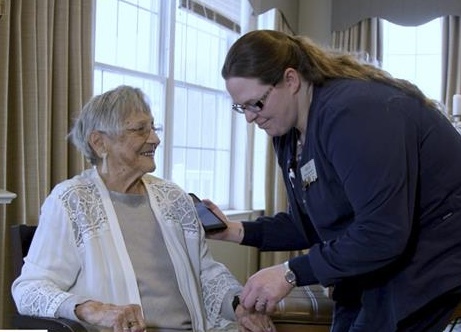
PITTSBURGH, Pa. – If IntegraCare’s senior living residents lived in single-family homes, they would rely primarily on themselves to take over 7,000 medications daily. That’s not easy because every medicine needs to be available in the correct dose, taken at the proper time, with all these factors potentially changing as doctor’s orders change.
Simply put, there are a lot of ways that could go wrong.
Instead, residents tap into IntegraCare’s high-quality medication management program. “Excellence in medication management can’t depend on individual memory or simply asking people to be careful,” said Larry Rouvelas, CEO of IntegraCare.
IntegraCare built its system on disciplined processes, multiple layers of protection, continuous monitoring, and a culture in which team members are expected to stop and ask questions whenever something doesn’t look right.
Through early September 2026, IntegraCare team members had provided 4,361,060 medication management and support regimens to senior living residents, achieving an impressive 99.9999916% accuracy rate in managing their medications.
Excellence is built into the process
Medication management may happen thousands of times each day, but IntegraCare doesn’t treat it as routine. Multiple layers of safeguards protect every medication pass.
“Orders must be accurate. Medications must be reconciled. Changes must be communicated and documented,” said Miranda Coulter, IntegraCare Area General Manager. “The medication on the cart must match the order. The resident must be correctly identified. The administration must be documented. And when a discrepancy occurs, it must be recognized, investigated and resolved.”
Team members are taught not to make assumptions.
“If something doesn’t look right, they stop. They verify. They question. They clarify,” McQuaide said. “Because in medication management, assumptions create risk.”
That philosophy is at the heart of IntegraCare’s approach, which focuses on the discipline behind the outcome.
“Our team realizes the importance of the process,” Coulter said. “The checks, reconciliations, documentation, audits, follow-up, education and accountability that make safe medication administration repeatable.”
One careful medication pass is good practice. Performing thousands of them safely, day after day, across multiple communities and states requires a culture and operating system designed for consistency.
Test the system
IntegraCare recently transitioned its medication-pass and clinical operations to a new electronic health record. The platform by Extended Care Professional (ECP) went live on Aug. 3.
The transition was a significant undertaking that provided an opportunity to measure how well IntegraCare’s underlying processes and teams could perform through change.
The results were striking. IntegraCare’s medication compliance rate was 98% on Day 1 of the transition, which ECP asserted was the highest they had ever seen on the first day.
For IntegraCare Chief Operating Officer Belinda McQuaide, the numbers represent something much bigger than a successful technology implementation.
“They’re a testament to how tightly our teams prepared and managed this transition,” McQuaide said. “And, more importantly, they illustrate the discipline that exists in medication management every day. Not just when a new system is introduced.”
Preparation
The strong electronic health record (EHR) transition did not happen overnight.
IntegraCare teams began preparing well before the new system went live. Coulter said the preparation included extensive collaboration with the Extended Care Professional team, hands-on training and opportunities for team members to practice before they were expected to use the system in their daily work.
ECP worked directly with IntegraCare to configure the platform around the organization’s needs. Additional training followed, including two days of hands-on instruction.
IntegraCare also held a two-day, in-person offsite training that allowed team members to practice using real data from their communities.
In the weeks leading up to “go-live,” information sessions helped teams understand what was coming. Then, as the transition approached, IntegraCare added another layer of support.
“Teams could log in ahead of ‘go-live’ to make sure they had the proper credentials and were ready to begin,” McQuaide said. “During the first day of implementation, support was available from 5 a.m. until midnight, giving team members an immediate place to ask questions, troubleshoot issues and reinforce their training.”
That support continues as teams become increasingly comfortable with the new platform.
Coulter credits that preparation and the attitude of the teams themselves with helping make the transition so successful.
“I am so proud of our teams as they worked through these important steps,” Coulter said. “They have embraced it and kept an open mind. Our team members are looking at the bigger picture, not just all that went into this transition. They are amazing.”
‘People make it work’
The new EHR brings meaningful capabilities to IntegraCare, including greater integration with other systems, customization and enhanced reporting. Beyond the technology, perhaps the real story is what the transition revealed about the organization using it.
“We simply outgrew the previous system, which had served IntegraCare well,” Coulter explained. “We needed a platform capable of integrating more effectively with the other systems and tools used across our communities.”
ECP also provides opportunities for stronger reporting and outcomes measurement. Those capabilities align closely with IntegraCare’s focus on using data to identify opportunities for improvement while also celebrating success.
The bigger picture
A 98% medication compliance rate on the first day of a major system transition is impressive. But perhaps the more important takeaway is why IntegraCare was able to achieve that result, and then push an already lofty percentage even higher.
The result wasn’t a product of a single training session, a new piece of software or a last-minute push. Months and years of building disciplined medication-management practices and a culture of accountability built a foundation.
More than 7,000 times every day, IntegraCare team members carry out a process that has no room for casualness.
“Behind every medication is a resident,” McQuaide said. “Behind every successful medication pass are layers of checks, communication, documentation, education and follow-through. And behind those layers are people who understand the responsibility of getting it right.”
For more information, contact Miranda Coulter, IntegraCare Area General Manager, at [email protected] or call 724.940.5544, Ext. 114.